


Hiring qualified drivers for company vehicles, trucks, and equipment is a crucial component of any organization’s risk management strategy. Driver behaviour affects safety, claim frequency, and insurance costs. Having a clear and effective system for assessing drivers is essential to ensure organizations avoid taking on unnecessary risk. This bulletin outlines practical steps to assess driver suitability and strengthen hiring decisions.
Driver Risk Categories
Drivers can typically be classified into three categories based on their driving records:
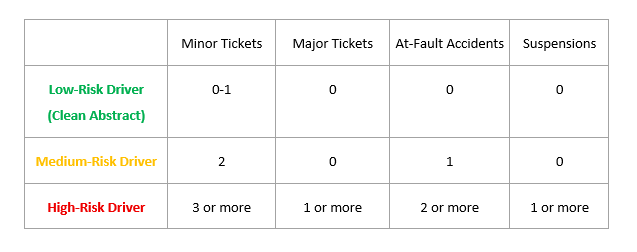
- Low-risk (clean abstract): no more than one minor ticket and zero at-fault accidents.
- Medium-risk: multiple minor tickets or one at-fault accident.
- High-risk: one or more major tickets, multiple at-fault accidents or a license suspension in the past.
The term “clean abstract” is often used when referring to a low-risk driver. As a general rule, a driver is often considered to have a “clean abstract” if they have no more than one minor ticket and zero at-fault accidents. This is a common benchmark for many insurers.
When determining risk levels, it is essential to utilize the following industry standard timeframes:
- Ticket History: within the past three (3) years
- Accident History: within the past six (6) years
- License Suspensions: throughout entirelicensing history
Minor infractions, such as speeding tickets or making an improper turn, are generally classified as low-risk. Major offenses, such as distracted driving or reckless driving, present as higher-risk. Similarly, accidents where the driver is found at fault are treated as high-risk incidents.
Utilize the table below, illustrating these classifications, as a quick reference guide:
Recommendation
RMA strongly recommends hiring or assigning only those drivers who fall within the low-risk (clean abstract) category. While some insurers may consider medium-risk drivers under specific circumstances, depending on factors such as driving experience or the nature of the infractions, high-risk drivers are generally declined for coverage. Adopting a similar approach to driver selection would be an effective strategy to limit your risk.
Hiring Inexperienced Drivers
In rural or remote areas, the pool of qualified drivers can be more limited. You may need to hire new or young drivers, or drivers with minimal work history. While inexperienced drivers naturally present a higher risk compared to seasoned drivers, implementing effective controls and protocols can significantly reduce that risk:
Pre-hire Screening Process
- Review driver’s abstract for convictions, infractions and suspensions.
- Set clear limits on acceptable violations. (for example, no major convictions and limited minor infractions).
- Plan to conduct semi-annual reviews of each driver’s abstract to ensure compliance.
- Confirm the driver meet medical fitness standards required for safe operation.
Training Program
- Require mandatory training covering defensive driving, use of equipment, company safety protocols and emergency procedures.
- Use supervised driving hours as a control. A range of 20–80 hours may be appropriate, depending on the vehicle type and the work.
- Introduce risk gradually. Start with daytime driving and simple routes. Progress to night driving, complex routes, and more demanding conditions as competency increases.
Monitoring & Performance Tracking
- Inexperienced drivers should only operate vehicles equipped with telematics and/or dashcams that monitor key factors such as braking, acceleration, speed trends, distracted driving, and following distance.
- Implement a probationary period (90-180 days) during which driving data is collected. Utilize information for coaching and performance improvement.
Company Policies
- Establish clear policies and enforce them consistently, including:
- No cellphone use while driving,
- Mandatory seatbelt use,No alcohol or drug consumption,
- Prompt reporting of all incidents, including near misses and vehicle damage.
- Adopt a zero-tolerance policy for safety violations or behaviors that pose a hazard to the driver, coworkers or the public.
Please reach out to the Risk Team at risk@rmainsurance.com for any questions or concerns relating to best practices surrounding driver hiring.