The Local Government Fiscal Framework (LGFF) is the primary operating and capital funding program available to municipalities and Metis Settlements. The capital funding component is legislated through the Local Government Fiscal Framework Act, which includes a revenue index factor that increases or decreases the total funding pool based on the percentage change in provincial revenues from three years prior. The LGFF Act also sets out capital funding formulas for charter cities, and the remaining funding is allocated to all other local governments based on a separate formula. Collectively these program components provide predictable funding to local governments, supporting long-term planning and capital investment decisions.
LGFF capital funding is split as follows:
|
Base Amount Needs-Component Population Tangible Capital Assets Amortization of TCA KMS of Local Roads |
$150,000 ($60,000 for Summer Villages) 3% of overall funding, based on needs factors 65% 15% 10% 10% |
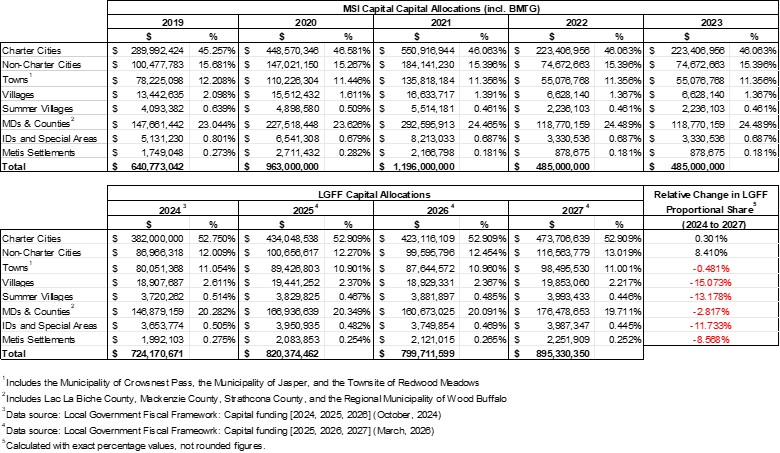
LGFF took effect in 2024 and replaced the Municipal Sustainability Initiative (MSI). Data published by Alberta Municipal Affairs suggests that in the final three years of the MSI program (including the Basic Municipal Transportation Grant funding), municipal districts and counties received approximately 24.5% of the total funding available. However, when LGFF took effect, the proportion of funding allocated to municipal districts and counties declined to approximately 20.3%.
Moreover, in 2027, rural municipalities are expected to receive approximately 19.7% of the LGFF capital funding, representing a 2.8% decrease in proportional funding share since the program took effect. Comparatively, over that same period, non-charter cities have experienced an 8.4% increase in their proportional share of LGFF capital funding.
With considerably more weight placed on population under LGFF (65%) relative to MSI (48%), the decrease in proportional funding received by rural municipalities under LGFF appears to be associated with the increased emphasis on population in the capital funding formula. While population is an important measure of operational demands, it does not adequately capture the costs of constructing and maintaining extensive road and bridge networks, especially in rural municipalities.
In its document titled Local Government Fiscal Framework: RMA Allocation Formula Reaction, RMA raised concerns with the 65% population weighting in the adopted formula, and notably identified that:
“…future grant allocations that redistribute a significant portion of funding to urban municipalities experiencing high levels of residential growth, while smaller urban municipalities that may be experiencing little or no growth, and rural municipalities that may be experiencing industrial growth, will receive a proportionally smaller share of funding” (pg. 7).
The allocation trends observed to date appear consistent with RMA’s concerns that municipalities experiencing limited population growth would receive a declining share of program funding over time. With rural populations generally stagnant or declining, Athabasca County is concerned that the gap in proportional funding between rural municipalities and larger urban centres will continue to widen, increasing the burden on rural taxpayers to sustain infrastructure that supports economic activity extending well beyond municipal borders.
Rural municipalities govern 85% of Alberta’s land base and support 28% of provincial GDP. Because rural transportation infrastructure supports key provincial industries, such as energy, agriculture and forestry, a funding model that relies predominantly on population does not fully reflect the infrastructure responsibilities and economic contributions of rural municipalities. Athabasca County believes that municipalities and the Government of Alberta are partners in creating the conditions necessary for business and industrial development, and that a funding model that fosters the sustainability of rural municipalities is essential to maintaining the infrastructure that supports long-term provincial economic growth.
RMA’s Rural Municipal Infrastructure Deficit Project has confirmed funding available to rural municipalities is insufficient to maintain acceptable condition ratings for roads, bridges and utilities. Furthermore, without timely investment, infrastructure conditions and asset value are expected to decline significantly, increasing longer-term risks to safety, service reliability, and overall lifecycle costs. RMA estimates that rural municipalities will face a $40.7 billion infrastructure deficit by 2028 if funding is not increased.
One of the challenges associated with a funding program of this magnitude is balancing the interest of all local governments while recognizing that the effectiveness of a funding formula should be periodically evaluated. As LGFF capital allocations up to 2027 are now published, sufficient data is available to assess whether the current formula continues to meet program objectives and appropriately reflects infrastructure responsibilities of rural municipalities.
Athabasca County believes there is merit to allowing local governments to choose between two allocation options. Under this approach, local governments could elect which primary infrastructure driver is most representative of their local circumstances. To preserve fairness and predictability, the option selected by local governments would be fixed for a multi-year period and reviewed at regular intervals.
One example of providing choice to local governments could be a local road network option or a population option, with the primary driver weighted at 65% and the remaining factors distributing the balance of funding, as follows:
| Local Road Network Option | Population Option | ||
| KMS of Local Roads | 65% | Population | 65% |
| Tangible Capital Assets | 15% | Tangible Capital Assets | 15% |
| Amortization of TCA | 10% | Amortization of TCA | 10% |
| Population | 10% | KMS of Local Roads | 10% |
Given the observed shift in funding distribution toward population-based factors, Athabasca County believes it is appropriate for the Government of Alberta to review the capital allocation formula and assess whether the current weighting assigned to population adequately reflects the infrastructure construction, maintenance, and lifecycle responsibilities of rural municipalities, particularly for roads and bridges that support Alberta’s economy.
Supporting Data
(MSI Data Source: https://open.alberta.ca/publications/municipal-sustainability-initiative-allocations)
(LGFF Data Source: https://open.alberta.ca/publications/local-government-fiscal-framework-allocations)